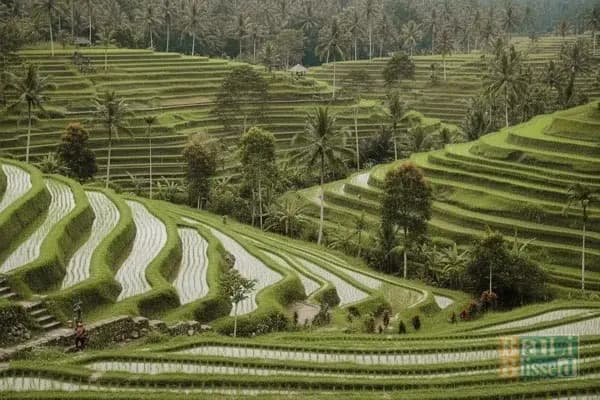
Jatiluwih
A UNESCO-listed rice terrace landscape in central Bali, with marked walking trails through active paddies and mountain views.
Jatiluwih sits in the cool highlands of Central Bali's Tabanan Regency, roughly 700 metres above sea level on the slopes of Mount Batukaru. The name means 'truly beautiful' in Balinese. More than 600 hectares of sculpted rice terraces stretch across the valley in layered green waves. There are no beach clubs or traffic here, just fields, mountain air, and the farming life that has defined the island for centuries.
UNESCO listed Jatiluwih as a World Heritage Site in 2012 because of its Subak irrigation system, a community-managed water distribution network that has sustained Balinese rice farming since the ninth century. Unlike smaller terraces like Tegalalang, Jatiluwih stays quiet. Farmers tend the fields with the same methods their ancestors used.
The Subak irrigation system
The Subak system is the heart of Jatiluwih. Dating back to the ninth century, it is a cooperative water management system that distributes water from springs, rivers, and canals across every terrace so each farmer gets a fair share. Temples scattered through the fields, such as Pura Luhur Petali, are where farmers gather to coordinate planting schedules and rituals.
Subak follows the Tri Hita Karana philosophy, the Balinese principle of harmony between God, nature, and people. This is what makes Jatiluwih more than a scenic viewpoint. It is a working cultural landscape.
| Feature | Details |
|---|---|
| Total area | Over 600 hectares (1,400 acres) |
| Elevation | ~700 metres above sea level |
| UNESCO status | World Heritage Site since 2012 |
| Irrigation system | Ancient Subak water management |
| Cultural philosophy | Tri Hita Karana (harmony of God, nature, and people) |
| Rice varieties | White, red, and black rice |
Trekking and walking trails
Jatiluwih has five official colour-coded trekking routes that wind through the terraces, bamboo forests, temples, and local farms. Each one gives a different view of the valley.
| Trail | Duration | Highlights |
|---|---|---|
| Red Trail | 45 minutes | Best panoramic views, ideal for first-time visitors |
| Yellow Trail | 1 hour | Passes through temples and cultural sites |
| White Trail | 1.5 hours | Deep valley experience with dramatic scenery |
| Blue Trail | 2 hours | Leads through local farms and working paddies |
| Green Trail | 2.5 hours | Extended rice-field trek covering the full valley |
The Red Trail is a good starting point. It is easy to follow and opens up to broad views across the valley. If you have time, the Green Trail takes you through the whole landscape at a relaxed pace. All trails are well maintained and suit most fitness levels.
Cycling and e-bike tours
Cycling tours let you cover more ground than walking. E-bikes have become common here because they make the hills manageable without exhausting you. Tours start from about IDR 400,000 and include a guide, helmet, and photo stops. Routes follow quiet backroads through villages, bamboo groves, and rice fields.
Best time to visit
Jatiluwih looks different each season. The dry season from April to October brings clear skies and firm trails. The wet season from November to March produces cloud cover and reflective water in the paddies.
| Period | Rice stage | What to expect |
|---|---|---|
| February - April | Planting season | Bright green seedlings, fields like mirrors |
| May - July | Growing season | Deep lush green, tall rice stalks |
| August - September | Harvest season | Golden landscapes, farmers harvesting |
| October - January | Off-peak / post-harvest | Peaceful and quiet, fewer visitors |
Good light for photography comes early, from 7:00 to 9:00, and again late in the afternoon from 16:00 to 18:00. February to April is the most popular window because the young rice plants turn the valley bright green.
Go between February and April for bright green terraces and reflective water in the paddies. Early morning and late afternoon give the best light for photos.
Entrance fees and opening hours
Jatiluwih is open daily from 8:00 AM to 6:00 PM. You can buy tickets at the main entrance gate or online at jatiluwih.id. There is a checkpoint on the main road where all vehicles are stopped.
| Category | Price (IDR) | USD equivalent |
|---|---|---|
| International adult | 75,000 | $5.00 |
| International child (5–12) | 50,000 | $3.30 |
| Domestic adult | 25,000 | $1.70 |
| Domestic child (5–12) | 15,000 | $1.00 |
| Bali local (KTP) adult | 15,000 | $1.00 |
| Bali local (KTP) child (5–12) | 5,000 | < $1 |
| Parking – motorbike | 3,000 | < $1 |
| Parking – car | 5,000 | < $1 |
| Parking – bus/microbus | 10,000 | < $1 |
The fee goes toward trail maintenance and the local farming community. Drone use requires a separate permit. It costs an extra IDR 150,000 to IDR 300,000 depending on the area.
Getting to Jatiluwih
Jatiluwih is about 50 kilometres northwest of Ubud in Tabanan Regency. The drive goes through winding mountain roads and small villages. The scenery gets better as you climb. Hiring a private driver for the day costs roughly IDR 600,000 to 800,000 and is the easiest option.
| Starting point | Distance | Travel time |
|---|---|---|
| Ubud | 40 km | ~1.5 hours |
| Canggu | 42 km | ~1.5 hours |
| Seminyak | 50 km | ~1 hour 45 minutes |
| Kuta | 54 km | ~2 hours |
| Sanur | 52 km | ~2 hours |
| Nusa Dua | 66 km | ~2 - 2.5 hours |
| Uluwatu | 75 km | ~3 hours |
Scooters are a flexible option if you are comfortable on mountain roads. Rentals run 70,000 to 100,000 IDR per day. Public buses do not serve the area, so you need a private vehicle or an organised tour.
Nearby attractions
Jatiluwih fits well into a full-day trip that covers several spots in the Tabanan and Bedugul regions.
Batukaru Temple (Pura Luhur Batukaru)
About 25 minutes from Jatiluwih on the slopes of Mount Batukaru, this is one of Bali's holiest temples and a starting point for hikes to the summit. It sits in dense jungle with cool, misty air and is far quieter than the crowded southern temples.
Yeh Hoo Waterfall
A short detour from Jatiluwih. Yeh Hoo is a multi-tiered waterfall hidden in the jungle. The walk down is steep, but there is a natural pool at the base that is swimmable in the dry season.
Bedugul and Ulun Danu Beratan Temple
About 30 minutes north of Jatiluwih, the Bedugul highlands have the Ulun Danu Beratan Temple on the shore of Lake Beratan. The area is cool, has a large market, and several garden attractions. It pairs naturally with Jatiluwih.
Many full-day tours combine Jatiluwih with Batukaru Temple, Yeh Hoo Waterfall, and Ulun Danu Beratan Temple. This makes a complete loop through Central Bali's highlands.
Dining and accommodation
A few warungs and cafes sit along the edge of the terraces with views over the fields. Gong Jatiluwih and Warung Dhea serve fresh coconut, Balinese fried rice (nasi goreng), and local snacks like laklak (rice flour cakes). Most have terrace decks where you can sit and watch farmers working.
Jatiluwih has only a handful of homestays, eco-lodges, and glamping sites. Most people visit as a day trip from Ubud or the southern resorts. Staying overnight gives you the sunrise over the terraces without the daytime crowds.
Practical tips
- Wear sturdy shoes. Trails get muddy after rain.
- Bring a light jacket. It is noticeably cooler here than on the coast.
- Carry cash. Most warungs and the ticket booth do not accept cards.
- Stay on marked trails and do not walk through active paddies. These are working fields.
- Drone flights need a separate permit paid at the ticket counter.
- Visit around 8:00 AM to avoid tour groups and catch the best morning light.
- Pair Jatiluwih with Batukaru Temple and Bedugul for a full day out.
Jatiluwih is a working agricultural landscape, not a theme park. The farmers tending the terraces are continuing a thousand-year-old tradition. Treat the fields and the people who work them with respect.